Is Mold Covered by Homeowners Insurance? What Sources Say
Whether a policy pays for mold depends less on the mold than on the water that caused it. This guide quotes what insurance regulators and the federal flood program publish, and puts the average claim figures next to published repair costs. It is general information; the policy itself and the insurer decide any claim.
Homeowners policies: the water event decides
The Texas Department of Insurance's homeowners guide lists among the risks most policies cover a “Sudden and accidental release of water or smoke” (Texas Department of Insurance, Homeowners insurance guide). Among the risks most policies do not cover it lists “A continuous water leak” (Texas Department of Insurance, Homeowners insurance guide). On mold specifically, it says policies “policies also won’t cover mold removal, except to repair damage caused by a covered risk” (Texas Department of Insurance, Homeowners insurance guide), and it names mold removal as an optional endorsement. Policy forms differ by state and company, so the declarations page and endorsements of the actual policy are the place to check.
Flood policies: mold is excluded with narrow exceptions
FEMA's FloodSmart site, which explains National Flood Insurance Program policies, is direct: “National Flood Insurance Program (NFIP) flood insurance policies will not cover damage from mold.” (FEMA FloodSmart (NFIP), Document damage and start clean up) It names limited exceptions, for example when “An authorized official has banned entrance to the area.” (FEMA FloodSmart (NFIP), Document damage and start clean up) or when “Floodwaters remain around the home, or in the area, impeding the policyholder’s ability to inspect” (FEMA FloodSmart (NFIP), Document damage and start clean up). It also tells policyholders to “begin cleanup and documentation immediately after a flood” (FEMA FloodSmart (NFIP), Document damage and start clean up), which matches EPA's drying guidance: “It is important to dry water-damaged areas and items within 24-48 hours to prevent mold growth.” (U.S. EPA, A Brief Guide to Mold, Moisture and Your Home)
What claims cost, against what repairs cost
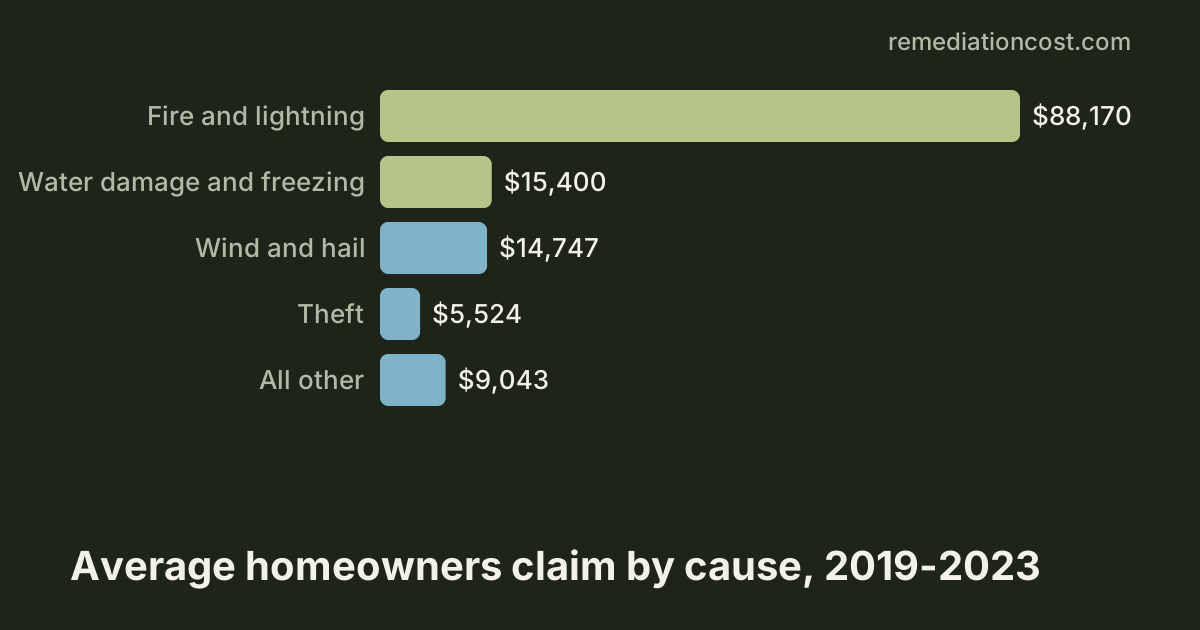
The Insurance Information Institute reports average homeowners claims for 2019-2023. It notes that “The loss category “water damage and freezing” includes damage caused by mold, if covered.” (Insurance Information Institute, Facts + Statistics: Homeowners and renters insurance)
Worked comparison using published figures only:
- The average water damage and freezing claim is $15,400; Angi's average whole water damage restoration job is $3,868, and its average mold remediation job $2,369. Claims run higher because they include repairs and contents, not only drying or mold removal.
- Water claims come in at 1.5 per 100 house-years, against 0.23 for fire and lightning; the average fire claim is $88,170.
For the cost side by area of the home, see water damage cost by area and mold removal cost by location.
Free routes first
Before paying anyone to argue a claim, the free routes are the insurer's claim line and agent, the policy documents, and the state insurance department, which handles consumer complaints about insurers. Remediation Cost does not handle claims and does not promise any outcome.
Sources
- Texas Department of Insurance, Homeowners insurance guide, checked 2026-10-20
- FEMA FloodSmart (NFIP), Document damage and start clean up, checked 2026-10-20
- Insurance Information Institute, Facts + Statistics: Homeowners and renters insurance, table “Average Homeowners Losses, 2019-2023”, checked 2026-10-20
- Angi, How Much Does Water Damage Restoration Cost? (updated Sep 11, 2026) and Angi, How Much Does Mold Remediation Cost? (updated Jul 9, 2026), checked 2026-10-20
Questions
Does homeowners insurance cover mold?
Usually only when the mold results from a covered water event. The Texas Department of Insurance says policies won't cover mold removal except to repair damage caused by a covered risk, and lists mold removal as an optional endorsement.
Does flood insurance cover mold?
FEMA's FloodSmart site says NFIP flood insurance policies will not cover damage from mold, with limited exceptions such as when an authorized official has banned entry to the area.
Is a slow leak covered?
The Texas Department of Insurance lists a continuous water leak among the risks most policies do not cover, while a sudden and accidental release of water is usually covered.