When Does Water Damage Become Mold? The 24–48 Hour Window
Water damage and mold are priced as two different jobs, and the difference between them is mostly time. This guide sets out the drying window that federal agencies publish and what the published cost guides charge on each side of it.
The window: 24 to 48 hours
EPA: “It is important to dry water-damaged areas and items within 24-48 hours to prevent mold growth.” (U.S. EPA, A Brief Guide to Mold, Moisture and Your Home) CDC gives the same span for floods: “Clean up and dry out your home fully and quickly (within 24–48 hours) after a flood.” (CDC, About Mold) For the air afterwards, EPA says “If possible, keep indoor humidity below 60 percent (ideally between 30 and 50 percent) relative humidity.” (U.S. EPA, A Brief Guide to Mold, Moisture and Your Home), and CDC sets a tighter ceiling: “Keep humidity levels in your home as low as you can — no higher than 50% — all day long.” (CDC, About Mold)
What each side costs
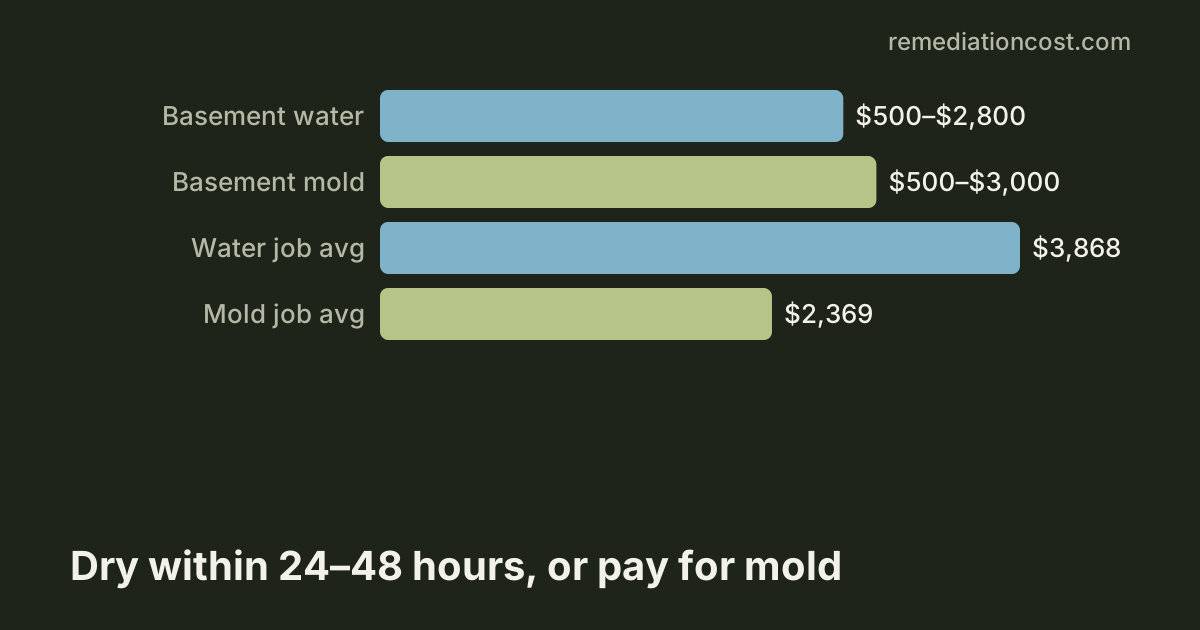
Angi's guides price the two jobs separately. For a basement, the water damage line is $500–$2,800 and the mold line $500–$3,000; across the home, the average water damage job is $3,868 and the average mold job $2,369.
Worked example with the published per-square-foot rates (arithmetic, not a quote): drying 100 sq ft of clean-water damage at $3.50 comes to $350; removing mold from the same 100 sq ft at $10–$25 comes to $1,000–$2,500, 2.9 to 7.1 times as much. And at 100 sq ft the mold job is past EPA's 10 sq ft homeowner line, in its medium category.
Water type matters too
The guide's per-square-foot rate climbs with contamination: clean water (Category 1) $3.50, gray water (Category 2) $5.25, black water (Category 3, includes sewage) $7.50. Sewage backup is black water. A flooded basement is priced in its own guide at clean water $1,500–$3,500, gray water $3,000–$7,000, black water (sewage) $7,000–$15,000.
Insurance after a flood
FEMA's FloodSmart site: “National Flood Insurance Program (NFIP) flood insurance policies will not cover damage from mold.” (FEMA FloodSmart (NFIP), Document damage and start clean up) and policyholders should “begin cleanup and documentation immediately after a flood” (FEMA FloodSmart (NFIP), Document damage and start clean up). Mold that grows because drying was delayed is therefore usually the owner's cost. See is mold covered by homeowners insurance and water damage cost by area.
Sources
- U.S. EPA, A Brief Guide to Mold, Moisture and Your Home (EPA archive copy) (read from the EPA archive copy), checked 2026-10-20
- CDC, About Mold, checked 2026-10-20
- Angi, How Much Does Water Damage Restoration Cost? (updated Sep 11, 2026), Angi, How Much Does Mold Remediation Cost? (updated Jul 9, 2026), Angi, How Much Does It Cost to Clean Up a Flooded Basement? (updated Oct 14, 2026), checked 2026-10-20
- FEMA FloodSmart (NFIP), Document damage and start clean up, checked 2026-10-20
Questions
How long before water damage turns into mold?
EPA says it is important to dry water-damaged areas and items within 24-48 hours to prevent mold growth; CDC gives the same window after a flood.
What humidity prevents mold?
EPA says to keep indoor humidity below 60 percent, ideally between 30 and 50 percent; CDC says no higher than 50 percent.
Does flood insurance pay for mold that grows later?
FEMA's FloodSmart site says NFIP policies will not cover damage from mold, apart from limited exceptions.